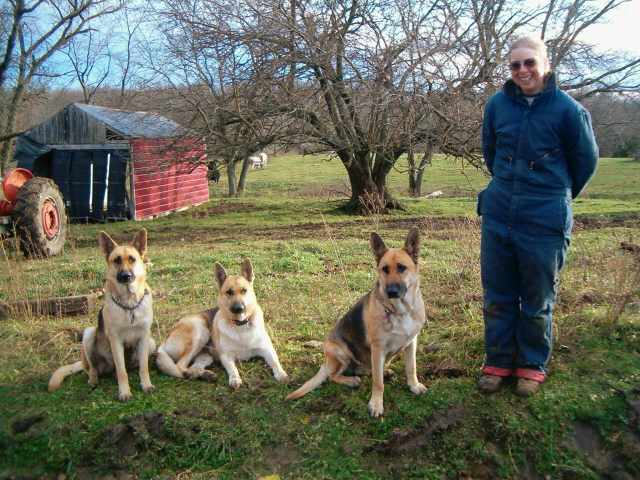
We live on a 230 acre farm just 4 miles from the small town of Cainsville, Missouri. Cainsville is located about 20 miles south of the Iowa border. Its about 100 miles due south of Des Moines, IA, and 110 miles north east of Kansas City, MO. The closest“big” town is Bethany,MO which is about 30 miles southeast.
The current price of our puppies is $500.00. We have tried to price them so that anyone who can afford to properly care for a large dog like our Shepherds can afford to buy one. We know the price is low, compared with other similar puppies, as you may have already discovered. Many people who have bought puppies from us have told us that we could get much more for them.
The pups are reserved on a first come first served basis. To reserve one, we require that you send us a $50 deposit. A personal check will be fine. We ask that you send it ASAP. The deposit is given to prove one's sincerity in wanting to buy a puppy. Ideally we would like for buyers to pick a puppy when they reserve it or as soon as the pups are distinguishable which is about 2 weeks after they're born. This is the only way other buyers can know what dogs are still available. If the photos on the website are not sufficient we can provide more.
If you inquire at a time when no puppies are available, we can add your name to our contact list and notify you when another litter arrives. We prefer not to take deposits too far in advance as circumstances can change.
We notify each buyer when the puppies are ready to go and arrange pickup place, date and time. At pick up time, we give you the puppy and relevant paperwork in exchange for the remaining $350.00 (preferably incash). We both sign a bill of sale. The bill of sale includes detailed information about your puppy such as last de-worming date and what shots the puppy has had. You will also be given a form to register the puppy with APRI in your name. Typically we like to get a photo of the puppy with its new owners to put on our website. The whole transaction takes less than half an hour.
After you pick up your puppy do not hesitate to contact us regarding any questions or problems you may encounter. It is important to us to know that we have given you aquality animal that you will be satisfied with for many years.
It is important to us that all of our puppies go to good homes. Therefore, when a person inquires about purchasing a puppy we like to know a little about their setup and how they plan to provide for their dog. Without being invasive we like to be comfortable with the situation our puppies will be entering. Below are some questions we may ask.
Have you owned a GSD or large dog before ?
Do you have a yard and if not how will your dog get exercise ?
If no one is at home all day how would the puppy be cared for ?
Are you interested in a male or female ?
Are you looking to buy a dog for breeding ?
We also ask inquirers for contact information such as their name, phone number and email address.
Yes,unlike some breeders we let our buyers choose the puppy that they want. The choice is made in the same order that we received the deposits. We request that the buyer choose when the pups are about 2 weeks old. By this time their eyes will be opening and they will show a little personality. We understand it is often difficult to decide on a pup when they are so small and cute. Part of selling our puppies is listening to the requests of buyers and then helping to match them up with a dog that best meets their needs. If a person tells us what they are looking for in a dog, (behavior,color, size, etc.) we do our best to help them in their choice. All of our past buyers have been very pleased with their puppy though most did not pick them out in person. They have found us to be helpful and honest in our representation of our pups (read our buyers’ comments on the puppy pages). We keep our website updated with current photos of each puppy every week. We can also send additional photos if requested. Of course, you are welcome to come to our farm to see the puppies and pick one out.
We let our puppies go to their new homes at about 6 weeks of age. We do not ship our puppies. If we did, the shipping cost could be more than the price of the dog. We do not want to get involved in this area. The pups are being raised on our farm in North Central Missouri. Buyers are always welcome to come to our farm to pick up their puppy. This can be an enjoyable family outing. If driving from the Chicagoland area the trip is about 450 miles.
In terms of a guarantee, we do not want you to keep a puppy you are not happy with. We would refund your money, but the puppy would have to be returned at your expense within a reasonable amount of time. All of the people who have purchased dogs from us are very happy witht heir puppies. We believe that after you have owned one of our dogs for six months nothing will be able to entice you to part with it.
We do not have hip guarantees. None of our dogs have been tested for hip displaysia. We tell our buyers that our dogs are very active, and none of them show any hip problems. Our dogs do a lot of jumping. You can find out the ages of our dogs by going to our GSD home page. While ours are large dogs, they have not been bred solely for size,which we believe can contribute to hip problems. Neither does their size affect their agility. During the 1990’s my uncle, who lived with us at the time, had an AKC registered, show quality GSD. He was a large beautiful animal. This dog had a hip guarantee. By 8 years of age he showed pain in the hips and had trouble climbing stairs. Most hip guarantees are for only 1 to 2 years. They also bind the owners with rules and give the sellers the right to checkup and monitor the dog they supposedly sold. We feel this is unnecessary and invasive.
Yes, the puppies are registered both with AKC (American Kennel Club)and APRI (America‘s Pet Registry Inc.) and come with a both registration forms. We raise purebred AKC & APRI registered GSDs.
Here's how it works. When a litter of pups is born we fill out a form which states the parent’s names, number of pups (male and female), and date of birth and submit this to the registry. The form is then processed registering the entire litter. Then they send us a registration form for each puppy using the litter number followed by a letter which we assign to each puppy. When you purchase your dog we give you this form. If you desire, you can fill the form out and for a small fee be able to register your puppy under your name. In return they will send you a Certificate of Registration.
Many people are unfamiliar with this registry but its popularity is growing.APRI is another registry like AKC. It is “An international association dedicated to the preservation and promotion of pet ownership and the professional pet industry… dedicated to…promote the humane care of animals, the preservation of bloodlines and the individual rights of pet ownership by providing support, information and solutions, as well as prompt, economical and second-to-none services for responsible pet owners, breeders, distributors, veterinarians, retailers and pet product manufacturers.”
We bought our 3 original dogs already registered with APRI. Their previous owner told us that it was much easier dealing with APRI and that AKC took too long to process and was more of a hassle. The choice of registry is not as important to us as the choice of dog we breed. We own and breed beautiful, good quality, purebred GSDs. Here is a link to another dog breeder’s website that goes into more detail about APRI Mateer Labradors.
AKC does not register APRI registered dogs. However, APRI registers AKCs.
We are not a puppy mill or large scale operation. Raising a litter of puppies for two months takes a considerable amount of our time, and while we enjoy doing so, we have a lot of other responsibilities on the farm that need our attention. Also, our breeding dogs are our personal pets. When they are producing puppies that becomes their primary responsibility. It also takes a lot of strength on the part of the mothers to bear and nurture the pups. For these reasons we typically breed them only once a year. Our dogs are usually bred in December and give birth in February. However, we could make exceptions to this rule.
Our puppies are born in our house where we can monitor them closely and assist the mother if necessary. Soon after they are born we place colored collars on them for identification and record their birth weights. We monitor their weights at least weekly and insure all are getting enough nutrition. At one week old we are able to distinguish whether they will be a lighter or darker colored dog. At about two weeks old their eyes open and they begin to hear. At this time we start de-worming them with a drug called Piperazine and continue to de-worm them every 2 weeks. Between two and three weeks old we start feeding them “puppy cereal”. This consists of ground up dog food soaked in water and mixed with milk. It resembles brown Cream Of Wheat and the puppies love it. As the puppies get older we switch to whole kibbles soaked enough for them to chew it.
By the time they are three weeks of age they are moving around on all fours. When they are about 4 weeks old they are too noisy and messy to continue to keep in the house. They are moved to our outside facilities, weather permitting, where they are able to run and play. At six weeks old they are given their first puppy shot and are ready to go to their new homes.
We do not have our puppies examined by a vet. We could have that done but there would be an added cost ($75-$100 per pup). These pups are well taken care of and we never have a "runt". We are around them all of the time and get to know their different personalities. These are not kennel dogs. None of our puppies have ever had kennel cough. We update our website with new photos of each puppy every week.
When the puppies are first born they are almost entirely black in color. As they mature they tend to get lighter. The pups that have brown heads should have tan faces and black saddles. The amount of tan on the pup’s face has been a determining factor as to how light the rest of the body will get.
We have a feature on our website that allows you to see what some of our puppies look like full grown. If a buyer has sent us a photo of their dog you can view it by clicking on the photo taken of them and their pup at time of purchase. This is the best way to see how a certain colored pup will turn out.
The puppies typically weigh from 10 to 15 lbs depending on how old they are when we sell them. You may want a box or pet carrier to use to confine your puppy if you have a long way to travel. The puppy will be about 12” to 15” tall to the top of the head and about 20 inches long from nose to base of tail. You may want to buy a leash and collar. A 14” collar should fit for a while. When full grown he will weigh between 80-100 pounds and have a 20” to 22” neck. You may decide to wait until after you pick him up to buy a collar.
There are 2 sets of needs to prepare for with your new dog. The first is what he will need as a puppy. These will be short lived. The second is what he will need for the rest of the time you have him.
When you bring him home he may appear shy and whinny. This is normal and will go away as he forgets his old surroundings and gets comfortable with his new ones. Give your puppy some things to chew on (toys) and teach him early what he is allowed to chew and what will not be tolerated. You will also need some simple grooming items (brush and curry comb). One of our buyers likes to quip that he bought a “Registered German Shedder”.
One of the first things you want to do is house train your puppy. Typically the puppies learn on their own not to dirty in their house. Once "home", if you watch your puppy and take him outside regularly, he should be easy to house train. Some people "crate train" their puppies. This means when they are not home, the puppy is in a cage. The puppy naturally does not want to make a mess where he must lay. Therefore he waits (within reason of course) to be let out of the cage to do his business. By immediately taking the puppy outdoors,he learns the routine. Then when the puppy is trained, the cage may be eliminated.
As the puppy grows, he will need more permanent sleeping accommodations. You may want to provide a rug somewhere in the house that he can call “his place” especially if you have another (older) dog in the house. A large dog bed is fine, but we recommend one made of vinyl. Cloth beds are havens for parasites. Be sure your puppy/dog gets plenty of daily exercise. Exercise not only directly affects body growth and development, but will also increase his appetite. Your adult dog will need a collar (20-22 inches) as well as a choker for training. A strong leash is also a must.
GSDs are strong and extremely intelligent yet every pup needs discipline. While the German Shepherd Dog is a wonderful family pet, it usually needs one member of the family to be its "master". As master that person should get the most enjoyment, willingness and respect from the dog. In other words, a dog becomes very attached to a kind but firm master. Remember, GSDs are "people dogs" and your dog will thrive on human companionship. This makes them very ill-suited to owners who, “just don’t have time for them” and put them out on aleash all day. Owning one requires patience and dedication on the part of the master. In addition to the many benefits of owning a German Shepherd Dog, a pet can be invaluable in teaching children responsibility, kindness and the right use of authority.
You have probably seen the photos of our dogs running freely on our farm. That's the beautiful part. Along with it comes exposure to parasites. We emphasize to every one that farm raised animals are exposed to an array of parasites. These pests are controlled, but it is not feasible to eliminate them. This is true of our horses, cattle and poultry as well as our cats and dogs. We (on the farm) must spend more time and effort fighting these parasites than those who dwell in the city.
De-worming your dog regularly is something that must be done throughout his life, but it must be done more frequently if the dog is living in a country environment. Once your puppy is away from other livestock, and put on a good de-worming program, re-exposure should not happen as frequently. Here is a quote from a reliable source: (TheComplete German Shepherd Dog book: 1970).
“It has been shown that puppies before their birth may be infested by roundworms from their mother.... ...It may be assumed that puppies at weaning time are more or less infested with intestinal roundworms or ascarids (toxocara canis) and that such puppies need to be treated for worms. It is all but impossible to rear a litter of puppies to weaning age free from those parasites. Once the puppies are purged of them, it is amazing to see the spurt of growth and the renewal of their thriftiness.”
Besides the regular de-worming we give our dogs,we de-worm our mother dogs about 1 week before they are due to give birth. While we are sure the pups we sell are not worm free, everything about them indicates that parasites are not affecting their development. The worms that our puppies have are typical and should not be expensive for their owners to deal with. There are a number of worms a puppy/dog may have. The common ones are: Roundworms, Hookworms & Tapeworms. Less frequent worms are: Whipworms, Heartworms, and Coccidia (not a worm but a one cell organism). The various drugs mentioned below can deal with these parasites. Unfortunately, a single de-wormer will not deal with all of them. The de-wormers we employ contain (1) Piperazine) (2)Fenbendazole (3) Ivermectin, (4) Praziquantel and (5) Pyrantel Pamoate. Our puppies are de-wormed every two weeks starting at 2 weeks of age with a drug called Piperazine. Piperazine deals only with large roundworms (Toxocara canis andToxascaris leonine) which are the most common and most injurious worms of puppyhood.
Owners can purchase de-wormers from pet stores and de-worm their dogs themselves, or they can have a vet do it for them but it will cost more. Most puppy buyers however,choose to bring their puppy to a vet for a parasite evaluation. Parasites take the nourishment from the food your puppy eats and when infestation is severe, cause a puppy to be thin and not grow as quickly as it should. Other symptoms can include diarrhea and blood in the stool as well as bloating. The dog may also be lacking in energy and appear lethargic. Their coat becomes lusterless and their eyes are sunken and dull. In terms of pain, unless the dog has a severe case (you would call him sick), the treatment of de-worming is more uncomfortable than the worms. If you look at the pictures of our puppies you will agree that none of them come close to looking like they are affected by worms.
On the farm fleas and ticks are a constant annoyance to our various kinds of livestock. Like the worms, we have to control these pests. We have taken precautions to see that our pups do not have any of these pests at time of purchase, however we still recommend that you bathe your dog with a good flea and tick shampoo if we have not already done so. Although ticks are seasonal, appearing in spring and summer months, fleas can sometimes be a year round battle. We spray down the puppies’ housing facilities with insecticides for this purpose and if need be, we bathe each dog using flea and tick shampoo. Ticks are easily seen and are not tolerated on our puppies, but to ask if they have any is something like asking if anyone has a mosquito bite. Another insect preventive treatment we have used on our dogs and cats is “Flea Drops”. We have used flea and tick collars in the past but have found them to be of little value and a waste of money. If a dog is treated properly against these pests and general cleanliness is maintained reinfestation should be unlikely.
When the puppy left our farm it was eating about ¾ cup of moistened food three times a day and had dry food available at all times. We usually use the store brands (Wal-Mart’s Ol’Roy), but any good dry dog (or puppy) food will be OK. You may want to continue moistening the food with a little milk& water for a while as we have been doing and then graduate to dry food. There should be no problem for the puppy to adapt to your schedule of feeding. It would be a good idea to weigh your puppy periodically to track weight gain.
In addition to commercial dog food our dogs get plenty of meat scraps and bones. Rawhide dog bones are good as well as dog biscuits. Treats are ok, but be sure not to spoil your dog with them. Fresh water should be available at all times.
Your puppy should start with a series of 3 shots. The first shot we give at 6 weeks of age. We are currently using Solo-Jec 5. It is a 5-way shot. The other 2 shots in the series should be given at 9 and 12 weeks. This is best done by a veterinarian.
Rabies vaccine is typically not given until the pup is about 12 weeks old. It is required by law (in most states) that it be administered by a vet.
We suggest you purchase a good book on dog training. Other good sources for training information can be gleaned from the internet.
A puppy can learn the common commands (sit, stay, come, go outside, etc.) at a very young age. Here are some important points to remember when working with your dog:
Call his name first, before you give him a command. A dog likes to hear his name called and by doing so you are sure to have his attention.
Make your commands brief such as: “Ranger, sit”or “Valour, speak“.Do not say, “lets hear you speak now, Valour“.
Always use the same vocabulary in issuing commands. Changing them may confuse a young dog. Do not say at one time “Ranger,give paw” and another time “Ranger, shake hands“. A GSD is smart enough to learn both commands but what’s the point ? It would appear that the trainer is the one that can not keep his commands straight.
Be patient with your dog. Sometimes it may seem like hours before he understands what you are asking him to do.
When it comes to reward and punishment the timing in which it is given is very important. Do not wait to correct or reward your dog. Be prompt. You can reward him with dog treats but I have found that a dog responds best to human emotions. If you have proven to be his“master” you will find that your dog is happy when you are happy, so cheer for him when he has done good. If your dog is prone to be very excited and playful the words “good dog” will be enough to give him the message. The same is true with punishment. One should use the tone of their voice to show displeasure when their dog has not done good especially if he already knows it. A short abrupt “NO” should let him know you are not happy with him.
One of the things I have learned being around GSDs is, it is one thing to own one (pay for) but it is another thing to have earned one and its respect. This lesson I learned from Valour, a dog I initially did not like, but in time grew to love for his utmost loyalty to me.